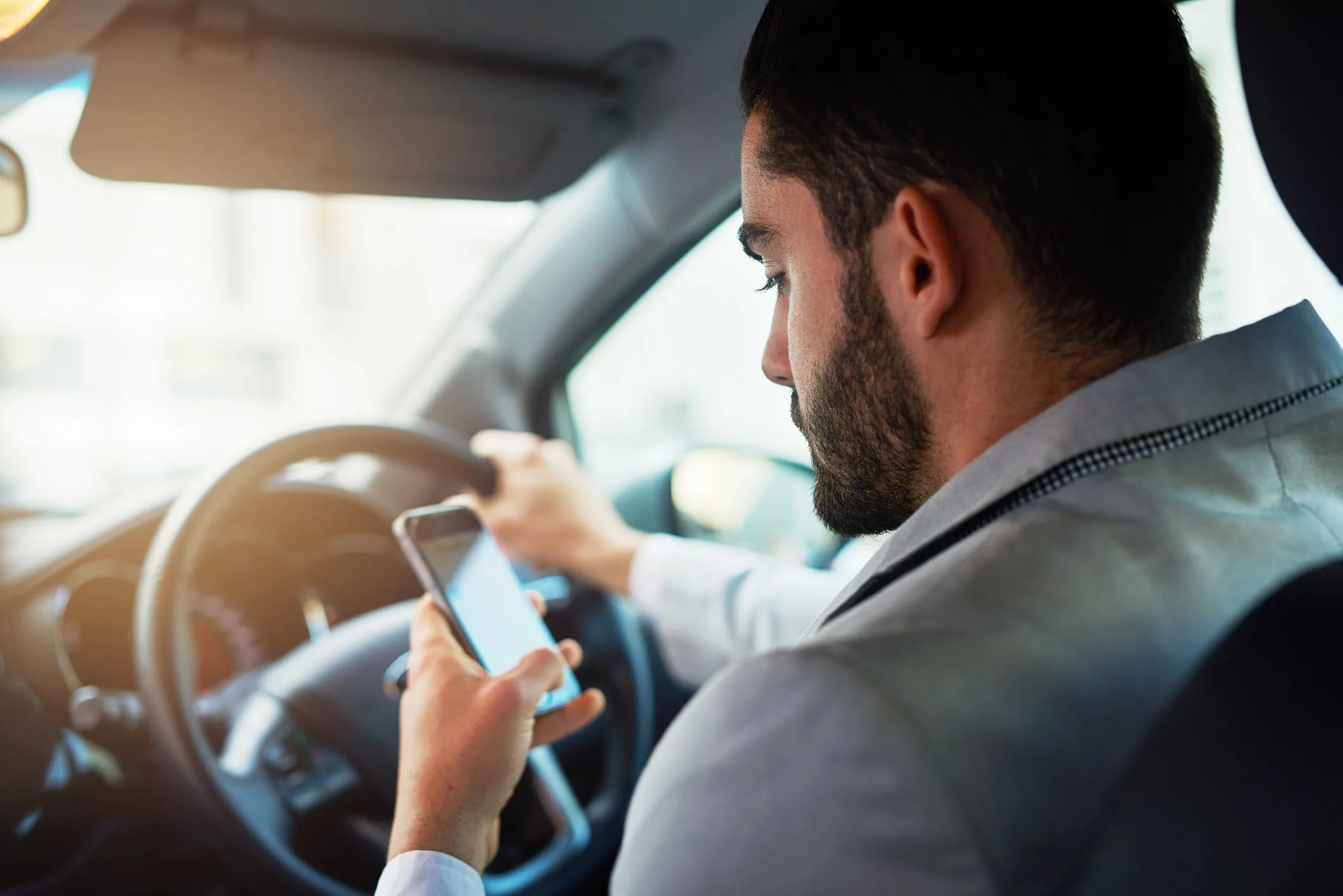
How dangerous is distracted driving?
Distracted driving is an ongoing issue, but it’s hard to measure exactly how pervasive the problem is. Other than anecdotally noticing far too many people consulting their phones as they nearly weave into your lane, it can be hard to measure the impact. Here’s what we know for sure:
- Distracted driving was directly responsible for the deaths of 3,308 people in 2022.
- That number might actually be higher as studies have found that distraction persists for a period even after the distracting activity has stopped.[1]
- One study reports that drivers engage in distracting activities as much as 50% of the time while driving…which is 2x more likely to lead to a crash compared to model driving (where drivers are alert, attentive and sober).[2]
This isn’t news to most of us. We know distractions are bad when behind the wheel, but so many of us do them anyway. We recently conducted a survey, to measure what activities people are doing behind the wheel in addition to driving.
Key findings
- 47% of people admit to sending or reading a text while driving – that’s a nearly 30% increase from when we did the same survey 3 years ago.
- Millennials and Gen Z are the most likely to send and receive text messages while driving (55%) while Boomers are the least likely (33%)
- Despite this, the vast majority of people (71%) believe that texting and driving is just as dangerous as drinking and driving.
What are drivers doing behind the wheel?
Ideally, model driving means your only focus when behind the wheel is on your vehicle, the road and the vehicles around you. But of course, we know that’s not the case. So just what are people doing behind the wheel?
This chart shows the answer to that question for the general population. However, there are some interesting generational differences to note.
- Millennials are more than twice as likely to apply makeup in the car than the general population. About 20% of Millennials admitted to doing this.
- Gen Z and Millennials are significantly more likely to send or read a text message while driving. 55% of people in both generations reported this behavior compared to 43% of Gen X and 33% of Boomers.
- Boomers are the generation most likely to report no distracting behavior while driving.
- 74% of Gen Z say they adjust a GPS device while driving, compared to 59% of the general population.
Most people know it’s against the law
In the survey, we also asked how aware people are of the laws around cell phones and driving in their area.
Interestingly, most people are aware of the laws in their state. In fact, only 16% of people said they weren’t familiar with the laws around cell phone use in vehicles. The remaining 84% reported being somewhat familiar to very knowledgeable about cell phone laws in their state.
If you are one of the 16%, here are a few facts you should know:
- 49 states D.C., Puerto Rico, Guam and the U.S. Virgin Islands ban text messaging for all drivers.
- 27 states prohibit all drivers from using hand-held cell phones at all while driving.
- Outside of the fully hands-free states, many states prohibit hand-held cellphone or all cellphone use by all or certain drivers in certain areas.
Here’s a chart to familiarize yourself with the laws around cell phone use while driving in your state:
Most people think it’s dangerous
In addition to asking about knowledge around laws, we also wanted to get a sense of how dangerous people think distracted driving is. We asked them to compare the relative danger of texting and driving to drinking and driving.
The vast majority believe that texting and driving is just as dangerous as drinking and driving.
This was true across generations: All ages agree that they think texting and driving is as dangerous as drinking and driving. There are some variances, of course. Boomers are the most likely to think both are equally dangerous (80%) and Gen Z is the most likely to think drinking and driving is more dangerous (30%).
Who's right? For what it’s worth, the number of fatal crashes in the U.S. where alcohol was a prevailing factor are about three times higher than the number of fatal crashes related to texting and driving.[3]However, while we have blood alcohol tests and legal definitions of what it means to drive drunk, it is harder to provide definitive proof of texting and driving unless it is directly witnessed. And as mentioned above, studies show distraction can persist even after the phone is put down. All of which is to say: by the numbers drinking and driving is more dangerous, but texting and driving is likely underreported. And as we know from this survey, it's quite prevalent.
Wrapping up
In this study, we learned that distracted driving behaviors and particularly texting and driving are happening more than in any previous survey we’ve done. We also learned that people are driving with distractions despite considering them dangerous and knowing they are against the law.
Remember to stay safe out there and keep your phone down when driving.
Methodology
The survey was conducted via Survey Monkey in March 2024 and received responses from 998 American drivers.